Manage server users

Introduction

To manage the users of your homeserver, navigate to the Users tab.

Use the search bar to find users within your homeserver, and use the export button to download the list of users in CSV format.

Add a user

To add a user to your homeserver, click Create in the upper-right corner of the menu. This menu allows you to create a new user on your homeserver.

  • User-ID*. Enter the unique Matrix ID (username) for the new user. This field is required.
  • Displayname. Enter the name that will be displayed in SalaX Secure Messaging.
  • Password. Set a password for the user. You can show or hide the password by clicking the eye icon.
  • User type. Select the type of user account, such as a bot or a support user. Leave it empty for a regular user.
  • Server Administrator. Toggle this option to grant the user server administrator privileges.
  • 3PIDs. Add third-party identifiers such as email addresses or phone numbers linked to the user account.
  • SSO. Add Single Sign-On information if the user will authenticate through an external SSO provider.
  • Click Save to create the user with the specified settings.

NOTE. If you enabled only the SSO method during installation, the users that you add through the admin portal will not be able to sign in to SalaX Secure Messaging.

View user details

Click the user account that you want to view.

User information

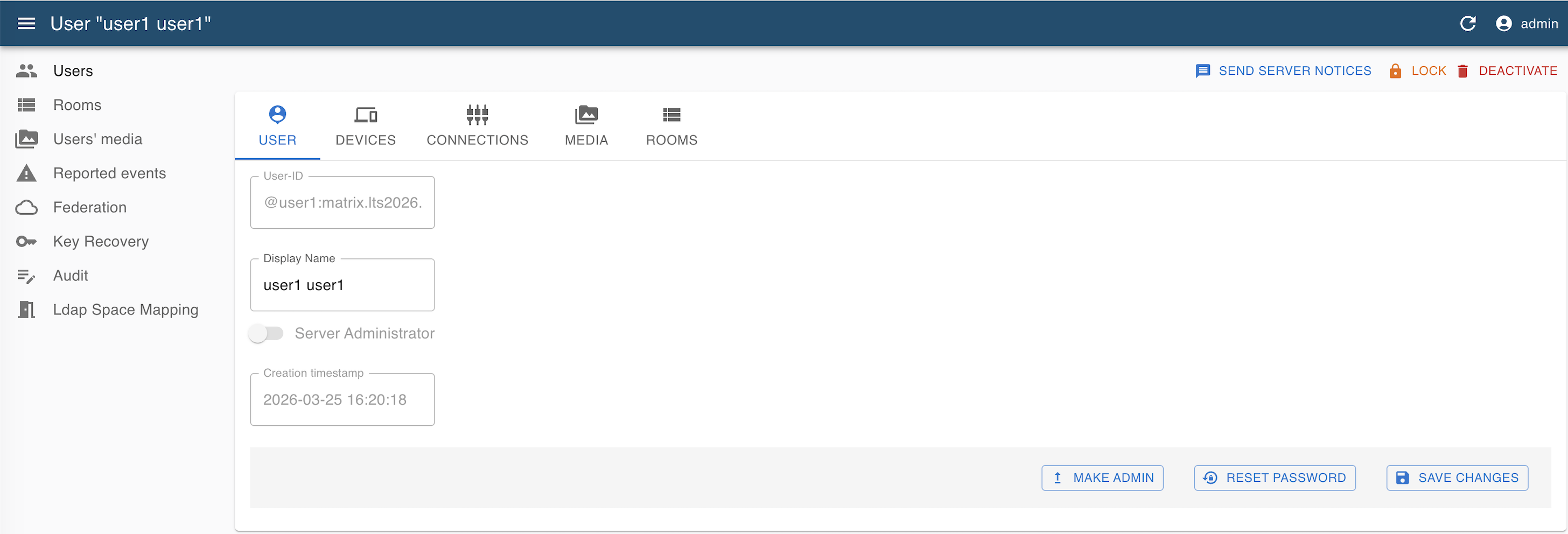
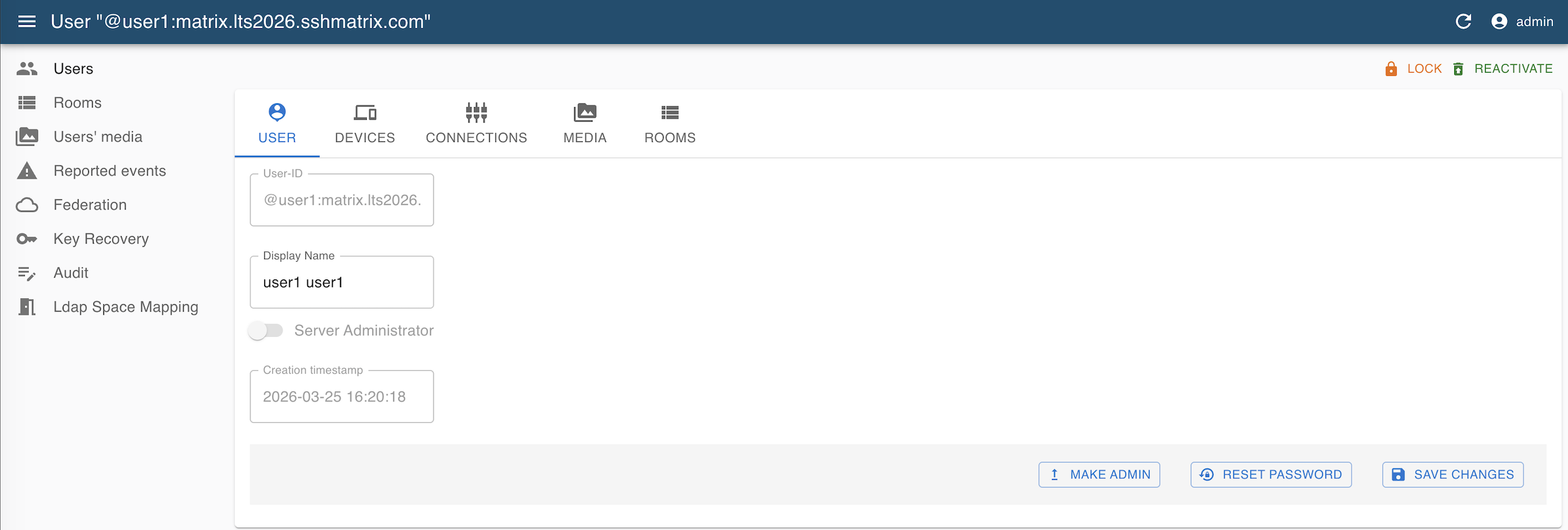
Under User tab, you can view the following details:

  • Avatar. Displays the user's avatar. It is possible to upload a new avatar or remove the existing one.
  • User ID. The unique Matrix ID (username) of the user.
  • Display name. The name shown in SalaX Secure Messaging.
  • Password. Used to set a new password for the user. This option cannot be used if the user was created using the SSO method.
  • User type. Specifies whether the account is a bot or a support user.
  • Server administrator. Assigns the user as a server administrator.
  • Locked. Locks the user's account, preventing login until unlocked.
  • Deactivated. Deactivates the user's account, disabling it until reactivated.

Email / Phone

This section allows you to add or edit the user’s third-party identifiers (3PIDs), such as email addresses or phone numbers.

SSO

Displays the user’s Single Sign-On (SSO) details.SSO is configured during the server installation process.

Devices

Displays all devices associated with the user’s account. Each device entry shows the Device ID, Device name, IP address, and Timestamp of the last activity. It is possible to remove a specific device from the user’s account.

Connections

Displays the user’s connection history. It shows details such as IP address, Date, and User agent for each connection.

Media

Lists all media files uploaded or shared by the user. Each entry shows details such as Media ID, Creation date, Last access date, File size, Type, and File name.

It is possible to download, quarantine, mark as safe from quarantine, or delete media files from this section.

Rooms

Displays all chat rooms that the user is a member of. It provides information such as room name, room ID.

Pushers

Displays the user’s push notification configurations. It lists details such as Kind, App display name, App ID, URL, Device display name, Language, Profile tag, and Pushkey.

This information can be to manage how and where the user receives notifications from SalaX Secure Messaging.

Remove a user account

  • Click on Erase User Data at the top right of the screen or Delete at the bottom-left of the screen. A confirmation dialog will appear.

  • Click Confirm to delete the user, or Cancel to keep the account.

Send server notice to a user

A server notice is a message sent directly from the server administrator to a user. It is received by the user as a direct message from "Server Notices" and is typically used to share important information such as maintenance alerts.

  • To send a server notice, open the user’s profile page and click Send Server Notices at the top right of the screen.

  • A message window will appear. Enter your message in the text box and click Send Note to deliver it to the selected user.

NOTE. This feature only works if "Server Notices" is enabled and properly configured on the server.